
When people search for a home, they’re not just choosing a property—they’re choosing a community. Yet for years, real estate search has focused primarily on square footage, price, and photos, leaving one of the most important questions unanswered:
Who lives nearby?
Local demographics provide the context that transforms a listing into a lifestyle decision. They help buyers and renters understand whether a neighborhood aligns with their stage of life, daily routines, financial comfort, and long-term goals. And as housing decisions become more intentional and data-driven, demographic insights have become one of the most valuable tools in modern home search.
Why Demographics Matter in Real Estate Decisions
Research consistently shows that buyers evaluate far more than the home itself. Surveys from the National Association of Realtors regularly find that neighborhood characteristics rank among the top factors influencing purchase decisions, often rivaling price and home features. Buyers want confidence not only in the property, but in the environment they’re moving into.
Demographic data helps answer questions people naturally ask but rarely see clearly presented:
-
Is this a young professional area or family-oriented neighborhood?
-
Are residents long-term homeowners or more transient renters?
-
Is the community growing, stable, or changing?
-
Do incomes and housing costs align with my budget?
-
Does the lifestyle feel active, urban, quiet, or community-focused?
These signals shape expectations about everything from noise levels and social activity to long-term property value.
Moving Beyond ZIP Codes and City Averages
One of the biggest problems with traditional demographic data is scale. Citywide statistics often mask enormous differences between neighborhoods just blocks apart. A single ZIP code may contain luxury condos, student housing, and family neighborhoods—all with entirely different demographic profiles.
Modern buyers need hyperlocal insight, not broad averages.
That’s why proximity-based demographic analysis has become increasingly important. Understanding population density, age distribution, income levels, and housing patterns within a small radius provides a far more accurate picture of daily life.
For example, a neighborhood with:
-
a median age around 38
-
high educational attainment
-
strong professional and healthcare employment sectors
-
a mix of renters and owners
suggests a stable, career-oriented community with long-term demand and strong economic fundamentals.
Introducing the Proximitii Demographics API
To make this level of insight accessible, Proximitii developed the Demographics API, a system that delivers hyperlocal demographic intelligence within a defined radius (normally 1 mile or less) around any address.
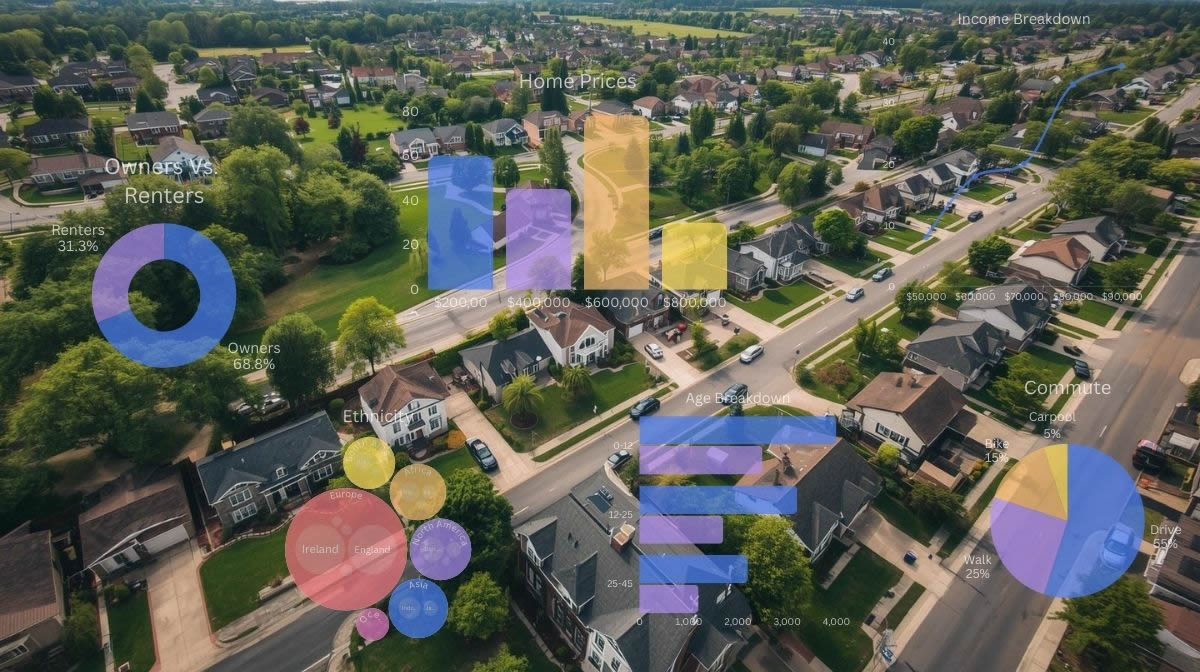
The Proximitii Demographics API returns structured, ready-to-use data including:
-
Population and density
-
Age distribution
-
Income and employment patterns
-
Education levels
-
Language diversity
-
Housing composition and tenure
-
Commute behavior and workforce industries
This allows real estate platforms, listing pages, and neighborhood guides to instantly answer the question buyers care about most: “Who lives nearby?”
Instead of forcing users to interpret raw census tables, the API delivers clear, structured insights that enrich property pages and keep visitors engaged longer.
What Demographic Data Reveals About a Neighborhood
Demographics provide powerful clues about how a neighborhood functions day to day.
Population and Age Distribution
Age breakdowns reveal lifestyle patterns. A large share of residents between ages 25–34 may signal a vibrant, social environment, while higher percentages of families or older residents often indicate stability and quieter surroundings.
Understanding age distribution helps buyers anticipate the social rhythm of an area long before moving in.
Income and Economic Stability
Income data helps buyers gauge affordability alignment. For example, areas with higher median household incomes and low unemployment rates often indicate strong economic resilience and long-term housing demand.
In one sample dataset, median household income exceeded $120,000 with unemployment under 3%, suggesting a highly stable local economy supported by professional and healthcare industries.
Education Levels
Education attainment is one of the strongest predictors of neighborhood stability and long-term growth. Communities with high percentages of bachelor’s and graduate degrees often correlate with higher property values, stronger local economies, and sustained demand.
Housing Patterns
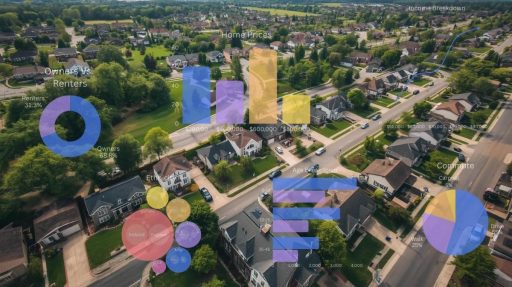
Demographics also reveal whether an area is renter-heavy or owner-focused, newly developing or long-established. A neighborhood with nearly 70% renter occupancy, for example, may appeal to urban professionals seeking flexibility, while higher ownership rates often attract long-term residents.
Commute and Lifestyle Behavior
Commute data paints a picture of mobility and daily habits. High rates of walking, public transit use, or remote work signal urban accessibility and lifestyle convenience—factors increasingly valued by modern buyers.
Why Buyers and Renters Care More Today
Several modern trends have elevated the importance of demographic transparency.
Relocation Is Increasing
Remote work and mobility mean more buyers are moving to unfamiliar cities. Without local knowledge, demographic data becomes a critical decision tool.
Lifestyle Matching Has Replaced Guesswork
People increasingly choose neighborhoods based on compatibility rather than reputation. Demographics help buyers quickly determine whether they’ll feel comfortable and connected in a community.
Confidence Reduces Decision Anxiety
Housing decisions are emotional and financial commitments. Clear demographic insights reduce uncertainty and help buyers feel confident they’re choosing the right environment—not just the right home.
Benefits for Real Estate Platforms and Professionals
For real estate websites and listing platforms, demographic data does more than inform—it drives engagement.
Adding hyperlocal demographic insights:
-
increases time-on-page
-
reduces bounce rates
-
builds trust through transparency
-
helps users compare neighborhoods more effectively
When visitors can immediately understand who lives nearby, they move from passive browsing to active evaluation.
Turning Data Into Understanding
The phrase “location, location, location” has always implied that surroundings matter. Today, demographics allow us to understand why a location feels the way it does.
Population trends explain energy.
Income patterns explain affordability.
Education levels explain stability.
Housing data explains community structure.
The Proximitii Demographics API transforms these insights into accessible, real-time information—helping buyers and renters see beyond the property itself and understand the people, patterns, and lifestyle that define a neighborhood.
Because ultimately, choosing a home isn’t just about where you live.
It’s about who you live among.